
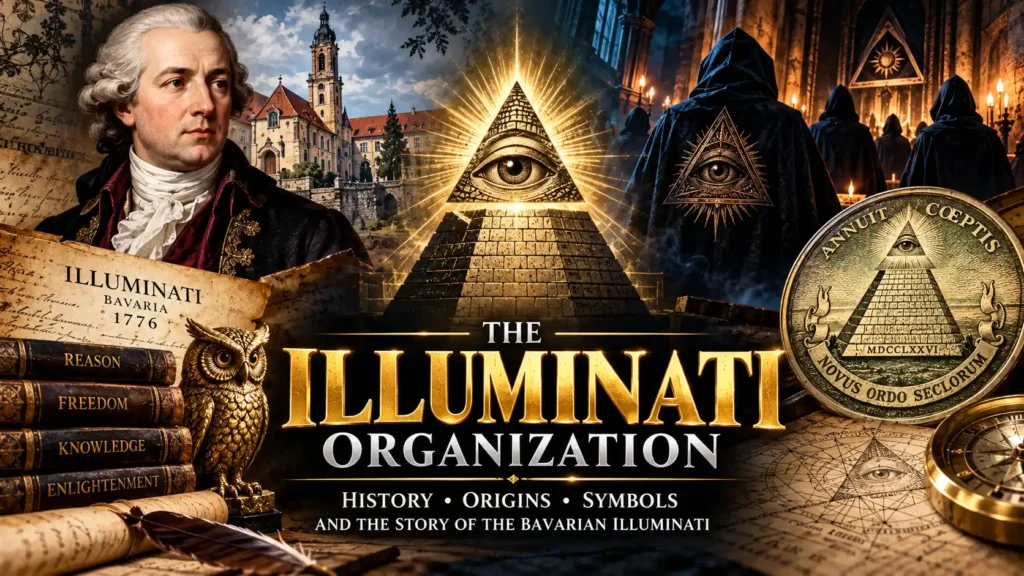
The Illuminati organization is one of the most recognizable names associated with secret societies and conspiracy theories. But behind the modern image of an all-powerful hidden organization is a much more specific historical story.
The original Illuminati was a real secret society founded in Bavaria in 1776 by university professor Adam Weishaupt. It promoted Enlightenment-era ideas involving reason, intellectual freedom, morality, and social progress. The organization existed for only a relatively short period before Bavarian authorities suppressed it.
What Was the Illuminati Organization?
The historical group is generally known as the Bavarian Illuminati, or the Order of the Illuminati.
Adam Weishaupt founded the organization on May 1, 1776, in Ingolstadt, Bavaria. His original aim was to create an organization that encouraged reason and intellectual development while challenging what he regarded as excessive religious and political influence over education and society.
The group initially consisted of Weishaupt and a small number of students. It later expanded through recruitment and developed a structured system of membership, secret communications, and internal ranks.
Who Founded the Illuminati?
The founder was Adam Weishaupt, a professor of law at the University of Ingolstadt.
Weishaupt was influenced by Enlightenment thinking and was critical of established religious and political authority. According to historical accounts, he initially called his organization the Perfectibilists before adopting the name Illuminati.
The organization later attracted members from educated and influential circles, including individuals connected with Freemasonry.
What Did the Illuminati Stand For?
So, what does the Illuminati stand for?
For the historical Bavarian organization, the answer is primarily connected with Enlightenment ideas such as reason, intellectual freedom, equality, morality, and the pursuit of knowledge.
The group sought to encourage members to question established assumptions and develop through education and intellectual discussion. It was not originally presented as the supernatural or world-controlling organization portrayed in many modern conspiracy theories.
The Illuminati and Freemasonry
The Illuminati and Freemasonry were separate organizations, although they became connected during the Illuminati’s development.
Some Illuminati members were recruited from Masonic circles, and Baron Adolph von Knigge played an important role in expanding the organization’s connections and structure. The two groups therefore shared certain members, practices, and Enlightenment-era influences, but they were not the same organization.
This distinction is important because modern discussions often combine the histories of Freemasonry and the Illuminati.
Illuminati Symbols
Modern popular culture frequently associates the Illuminati with an all-seeing eye, triangle, and pyramid.
However, these symbols should not automatically be treated as official symbols of the historical Bavarian Illuminati.
Historical accounts identify the Owl of Minerva as an important symbol used by Weishaupt’s organization. The eye and pyramid became much more strongly connected with the Illuminati through later interpretations, conspiracy literature, popular culture, and the blending of different symbolic traditions.
The Eye of Providence itself has a much broader history and was not created by the Illuminati.
Why Did the Illuminati Become a Secret Society?
Secrecy was an important part of the organization’s structure.
Members used code names and communicated through coded correspondence. The group also developed different levels of membership and encouraged recruitment through existing social and intellectual networks.
In the 18th century, secrecy could provide organizations with privacy while allowing members to discuss controversial political, religious, and philosophical ideas.
What Happened to the Illuminati?
The organization’s expansion eventually attracted political attention.
Bavarian authorities moved against secret societies during the 1780s. Illuminati materials, correspondence, and membership information were seized, and the organization was ultimately suppressed. Weishaupt went into exile, and the historical order ceased functioning as the organization it had been.
The suppression of the group did not end its influence on popular imagination.
Instead, rumors developed claiming that the Illuminati had survived underground and continued influencing governments, revolutions, financial institutions, and world events.
The Illuminati and Conspiracy Theories
Much of what people associate with the Illuminati today comes from later conspiracy theories rather than documented evidence about the original organization.
After the Bavarian Illuminati disappeared, writers and political commentators began attributing major historical events to an alleged continuing Illuminati network. These claims expanded over the following centuries and eventually became part of popular culture.
Modern books, films, television programs, music, and internet culture have further expanded the image of the Illuminati as a powerful hidden organization controlling world affairs.
There is an important difference between studying these theories as cultural phenomena and treating them as established historical facts.
Is There an Illuminati Official Website?
People sometimes search for an “Illuminati official website,” “Illuminati club,” or “Illuminati contact info.”
There is no verified modern continuation of the historical Bavarian Illuminati that can simply be identified as its official worldwide website or contact organization.
Websites using the Illuminati name may represent modern organizations, businesses, communities, entertainment projects, or individuals. The use of the name alone does not establish a historical connection to Weishaupt’s 18th-century organization.
Anyone researching such a website should examine its ownership, claims, historical evidence, and independent sources rather than assuming that the site represents the original Illuminati.
Historical Illuminati vs. Modern Popular Culture
The historical organization and the modern idea of the Illuminati are very different.
| Historical Bavarian Illuminati | Modern Illuminati concept |
| Founded in 1776 | Popularized through later culture |
| Associated with Adam Weishaupt | Often portrayed as an anonymous global organization |
| Influenced by Enlightenment ideas | Frequently linked to conspiracy theories |
| Used secret membership and communication | Often depicted as controlling world events |
| Suppressed by Bavarian authorities | Alleged continuation lacks established historical evidence |
Understanding this distinction makes it easier to separate documented history from speculation.
Frequently Asked Questions
Was the Illuminati a real organization?
Yes. The Bavarian Illuminati was a real secret society founded by Adam Weishaupt in 1776. It was later suppressed by Bavarian authorities.
What does the Illuminati stand for?
The historical organization was associated with Enlightenment ideals including reason, intellectual freedom, equality, morality, and the pursuit of knowledge.
Is the Illuminati still active today?
There is no established historical evidence that the original Bavarian Illuminati survived after its suppression in the 1780s. Claims about a continuing global Illuminati generally belong to later conspiracy theories rather than documented history.
What symbol did the historical Illuminati use?
The Owl of Minerva is documented as a symbol associated with the historical Bavarian Illuminati. The eye and pyramid commonly associated with the Illuminati today have broader histories and were later connected with the organization in popular culture.
Is the Illuminati the same as Freemasonry?
No. They were separate organizations, although the Illuminati recruited some members through Masonic networks and incorporated certain Masonic influences.
Does the Illuminati have an official website or contact information?
There is no verified official worldwide website or contact channel for the historical Bavarian Illuminati. Modern websites using the name should be evaluated independently and should not automatically be treated as representatives of the 18th-century organization.
